



Al contenuto della pagina

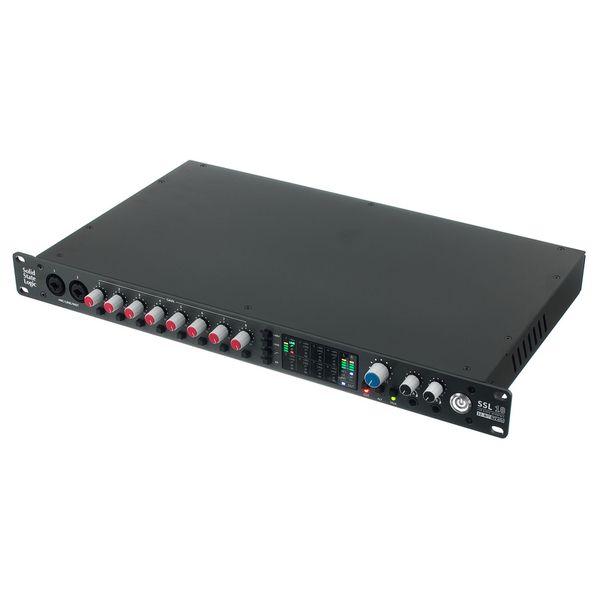
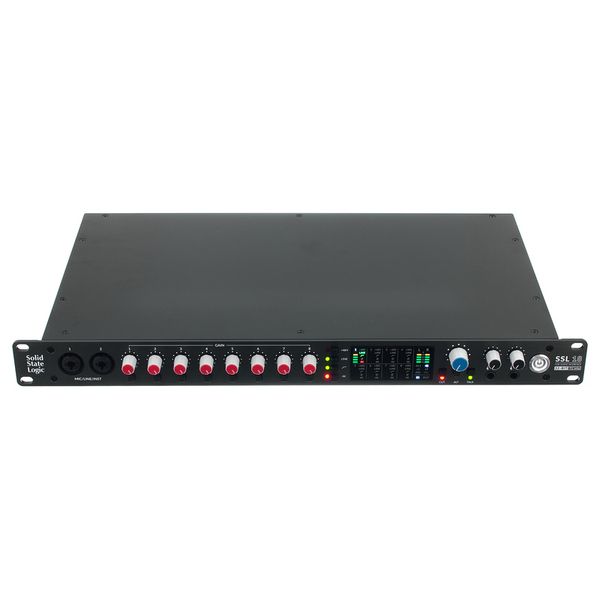
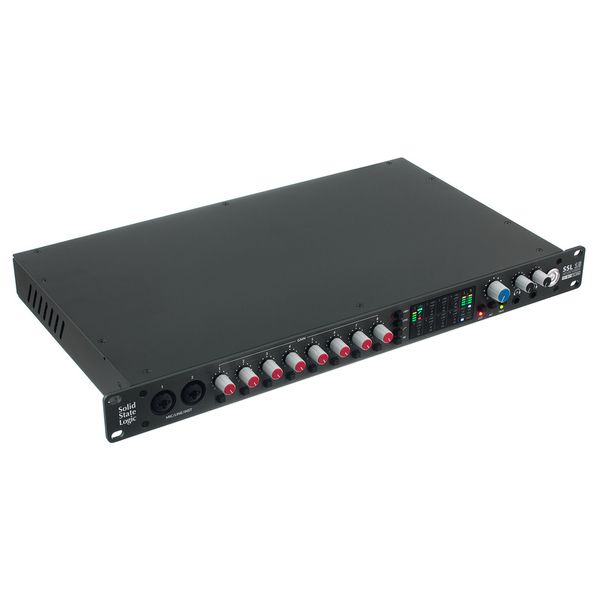
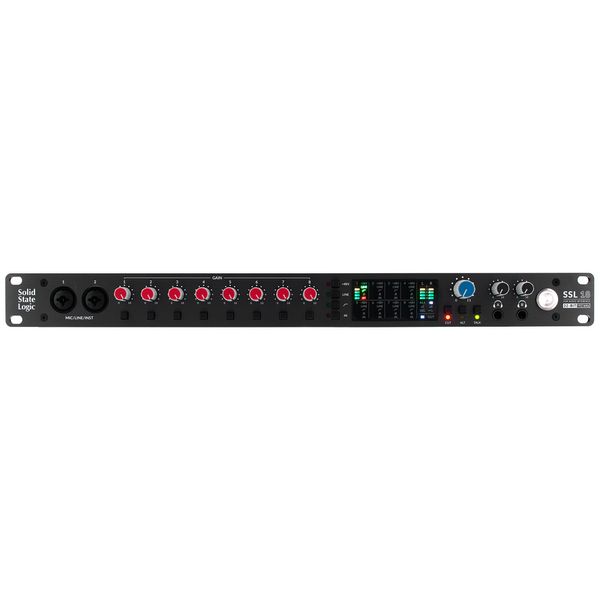
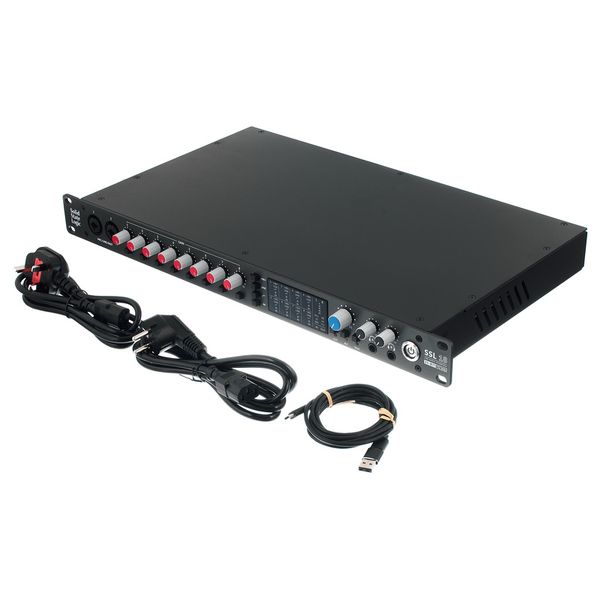
Interfaccia audio USB 26 In/28 Out

  • 32 bit/192 kHz
  • Livello operativo +24 dBu per tutti gli ingressi e le uscite
  • 120 dB di gamma dinamica in tutti gli ingressi e nelle uscite per cuffie
  • 125 dB di gamma dinamica nelle uscite monitor e di linea
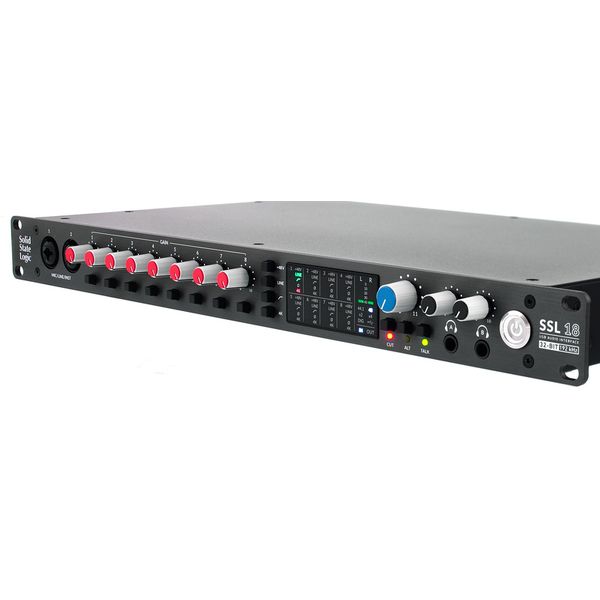
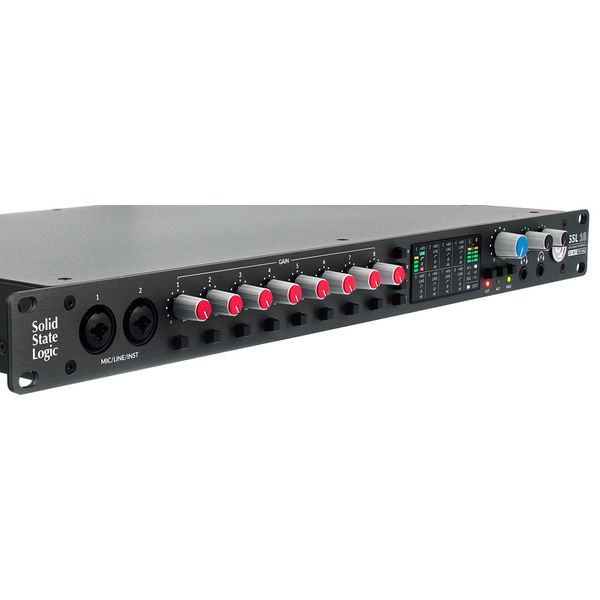
  • 8 preamplificatori microfonici (gamma di gain 67 dB, -130,5 dBu ON, +48 V, gamma dinamica 120 dB, HPF, interruttore 4K)
  • Ingressi 1/2 commutabili a livello strumento
  • Ingresso Talkback con compressore Listen Mic integrato (utilizzabile anche come ingresso di linea per gli Stems con LMC)
  • Interruttore Legacy "4K" per caratteristiche sonore ispirate alla serie SSL 4000
  • Stereo Loopback con sorgente Loopback selezionabile
  • Include il software SSL Production Pack
  • Controllo tramite applicazione software gratuita SSL 360° (incluso il mixer software SSL 18 a bassa latenza)
  • Dimensioni (L x P x A): 482,6 x 294 x 43,6 mm
  • Peso: 4 kg

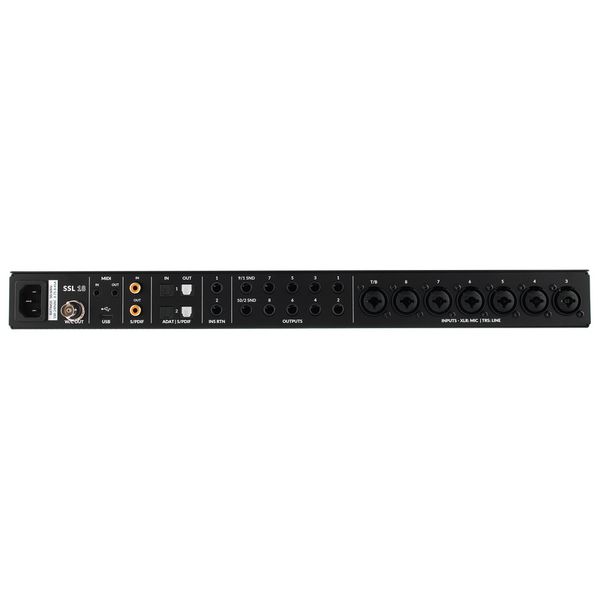
Collegamenti:

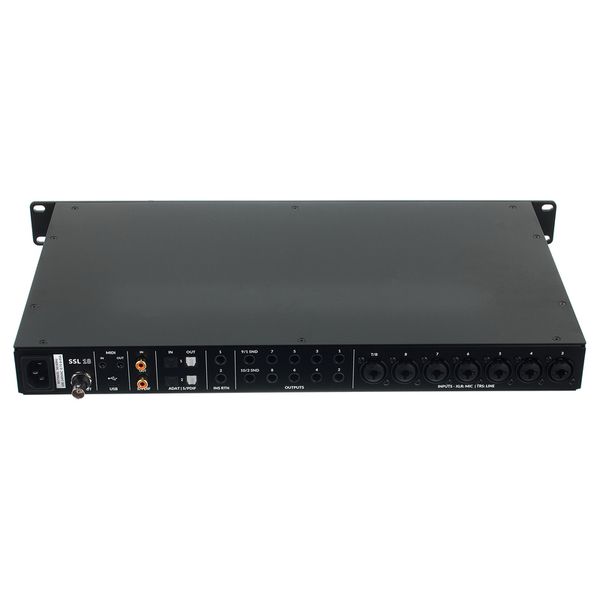
  • Ingressi combo microfono/strumento/linea: 2 XLR/jack da 6,3 mm
  • Ingressi combo microfono/linea: 8 XLR/jack da 6,3 mm
  • Ingresso combo microfono talkback: XLR/jack da 6,3 mm
  • 2 ingressi ADAT da 44,1/48 kHz (8 canali a 96 kHz)
  • 2 ingressi S/PDIF (coassiali o ottici)
  • Ingresso Wordclock: BNC
  • Ingresso e uscita MIDI: mini jack TRS-A da 3,5 mm
  • Uscite di linea: 10 jack da 6,3 mm bilanciati (+9 dBu/+24 dBu opzione per le uscite 1/2 e 3/4, 9/10 Send)
  • Return: 2 jack da 6,3 mm
  • Uscite per cuffie stereo regolabili separatamente con 3 livelli di impedenza (standard/alta sensibilità/alta impedenza): 2 jack da 6,3 mm
  • USB-C
  • In catalogo dal Marzo 2025
  • Numero di articolo 609316
  • Unità incluse 1 Pezzo
  • Recording / Canali di Playback 26x28
  • Numero di Mic Inputs 8
  • Numero di Line Inputs 8
  • Numeri di ingresso strumento 2
  • Numero di Line Outs 10
  • Uscite Cuffie 2
  • Alimentazione phantom Si
  • Numero di Connettori S/PDIF 2
  • Numero di Connessioni ADAT 2
  • Numero di Connessioni AES/EBU 0
  • Numero di Connessioni MADI 0
  • Ethernet 0
  • Altre Connessioni USB-C
  • Interfaccia MIDI Si
  • Word Clock 1xIn
  • Frequenza di campionamento massima (kHz) 192 kHz
  • Massima risoluzione in bit 32 bit
  • Alimentazione USB No
  • Incl. alimentazione Si
  • Versione USB 2.0
  • Larghezza in mm 482,6 mm
  • Profondità in mm 294 mm
  • Altezza in mm 43,6 mm
  • Tipo di Connessione USB-C
  • Incluso SSL Production Pack Software
  • Zero Latency Monitoring Si
€ 935
Tutti i prezzi incl. IVA
Disponibile fra circa una settimana
1
78
Visitatori
considerano questo prodotto
15
Classifica vendite
in Interfacce Audio USB

18 Valutazioni dei clienti

4.8 / 5

uso

Caratteristiche

Suono

Qualità

11 Recensioni

google translate gb
Sfortunatamente si è verificato un errore, La preghiamo di riprovare più tardi.
V
Great device, many gimmicks
Votanik 03.05.2025
I'm writing this review after a month of use. I purchased the SSL 18 to record rehearsals, replacing my twenty-year-old interface.

The difference is literally day and night. With the SSL, each instrument's frequencies are distinct, positioning in the mix is clear, transients are amazing, and the sound is incredibly clean in both playback and recording. At reasonable gain settings, noise is practically nonexistent.

That said, the SSL 18's clarity might be perceived (or actually be) somewhat sterile. I've worked with similarly clean interfaces like the RME ADI2 Pro FS, which offers both clarity and exceptional detail. (Note that I recognize the difficulty in describing sound quality, so please bear with me.)

Another interface I'm experienced with and would like to compare is the Prism Sound Lyra 2. If a Studer tape machine transformed into an interface, it would become the Lyra. This interface has incredible depth, sweet highs, and amazing bass extension. Between the RME and Lyra 2, the SSL 18 leans toward the RME – its sound is brighter and attempts the RME's analytical quality, which unfortunately (I think) it doesn't quite achieve.

To understand the differences between the SSL 18 and Lyra 2, I set up a stereo pair of KM184 microphones to record identical audio material (music and pink noise). Each interface played back and recorded itself through the microphones, which remained in the same position between recordings.

I expected a bigger difference. Listening to the recordings, I could barely tell whether I was hearing the Lyra 2 or SSL 18. The SSL 18 revealed itself only through slightly emphasized highs; otherwise, everything sounded the same. My conclusion is either I'm biased toward the Lyra 2, or the differences don't translate through microphone recordings. Despite similar results, I'm convinced the Lyra 2 has a more musical and sweet sound than the SSL 18 – though perhaps I'm just imagining it? I think not, you judge.

As a device, the SSL 18 seems well-built. All buttons have the right feel, and except for the potentiometers (which I must use since gain can't be controlled digitally), I generally control everything through the 360 application's control panel.

I'm not impressed with the 4K function and Listen Mic Compressor (LMC) – not because they sound bad, but because I was forced to pay for features I don't need. Both are gimmicks that ultimately burden the buyer. The 4K is just a marketing trick (reminiscent of 4K video's higher resolution) and likely has no relation to SSL 4000 consoles (unless they had permanent 3 dB or so high shelf boost). Even if it did, I don't understand why I'd need to print my tracks with enhanced highs – if I want more treble, I can add it in my DAW with any EQ and harmonic distortion I prefer. Today's plugins are excellent; people should abandon the hype around supposed "analog magic." I find nothing magical about 4K, though it sounds better than Focusrite's harsh "Air" feature (which started this unfortunate gimmick war).

The LMC also sounds good (better than expected), but it's for very specific cases. Again, these effects can be done in-the-box today. These plugins are emulations just like this compressor is an analog emulation of the original – you're not getting the authentic "LMC" circuit anyway.

The good thing about the LMC is that it gives you the Talk Back channel which, despite some limitations and reduced specs compared to the other channels, can be used for normal recording, effectively making it a 9-channel device – which is exactly why I bought it, as I needed exactly 9 channels.

While they give you 4K and LMC, they don't provide a Pad, which is a truly useful feature standard in serious preamps. I'd trade the 4K for a Pad function any day. When the line input trim is at maximum (input sensitivity is highest), there's noticeable noise that I wish was lower.

The 32 bit essentially is meaningless and serves more as marketing rather than something practical.

The 360 application is well-designed and relatively intuitive, unlike Prism's and especially RME's, which require a PhD to understand. Unfortunately, the control panel for buffer size settings is a separate application from 360, which is unfortunate – ideally, these would be unified. You can already set the sample rate in 360; why not include the rest?

Firmware updates are extremely easy, and the drivers are completely stable. Regarding application negatives: 360 always starts on the home page, forcing you to click on the console field every time, which becomes tiresome. The buffer size control seems to have a bug when the size is at maximum (an impressive 8192!) – first time I've seen a driver allow such a large size. I hope these issues will be resolved in future updates.

It's worth noting that the device lacks a Word Clock In, which exists in the Alpha 8. I hope SSL releases an expansion like the Alpha 8 but with SSL 18 preamps, because if someone wants 16 channels and buys the SSL 18 as an expansion, they won't be able to synchronize the devices properly. They'll have to rely on clock integration through digital audio via either ADAT or S/PDIF, which isn't ideal as it creates subtle jitter.

I'd be interested in such 8-channel expansion unit from SSL (I know about the PureDriveOcto, but that's not what I mean) as long as it has Word Clock in.

If this device is released, I might consider it, but this time I won't rush like I did with the SSL 18, which I paid about 60 euros more for than its current price.

Is not about the money, its because I can't help feeling cheated – either Thomann or SSL doesn't support early adopters.
That's bad.
Qualità
Caratteristiche
uso
Suono
56
0
Segnala un abuso

Segnala un abuso

google translate fr
Sfortunatamente si è verificato un errore, La preghiamo di riprovare più tardi.
h
Renouvellement parfait
here_a_microcosm 08.09.2025
J'ai pendant longtemps eu pas mal de cartes sons, elles avaient toutes leurs avantages et inconvénients mais d'un autre côté cela m'a permis de comprendre mes besoins.
Pour ma part il a été choisi de privilégier la qualité audio au nombre d'entrée, étant donné que de toute manière je n'aurais pas énormément d'instruments, une console de mixage n'était pas pour moi un bon choix tant surtout sur le fait qu'également il y a la place prise à prendre en compte.

Je ne change pas de pays car ma dernière interface audio fut une Focusrite Scarlett 18i20 de troisième génération, je ne perd pas au change en terme de qualité de fabrication mais j'ai quand même voulu en profiter pour monter un peu en gamme en ce qui concerne la qualité sonore.

L'interface est bien installé dans son emplacement rack et branchée avec le câble USB fourni par le constructeur car par chance la carte son a failli se retrouver a l'opposé de ma tour PC, même si j'ai pu discuter avec le service technique et que l'on m'a assuré qu'il n'y avait pas de problèmes particuliers mis à part la longueur de 3 mètres maximum à respecter, je ne voulais pas trop non plus me risquer à ça. Elle ne bouge pas car elle est uniquement utilisé dans un contexte de home-studio sous Windows 11 et Cubase 14 comme DAW. Les réglages et le routage se fait avec SSL 360° qui est très bien pensé. Pour ce qui est de la latence, malgré quelques commentaires un peu à la va-vite que j'ai pu rencontré sur le sujet, j'ai été nullement embêté à ce sujet.

Pour en revenir sur le logiciel SSL 360°, je le trouve très efficace. Il est simple et il permet de gérer la carte avec certains paramètres pas disponible en façade. Pour le moment je n'ai pas approfondie mon exploration mais je peux d'ores et déjà dire que le peu que j'ai fait, j'ai tout de suite trouvé ce que je voulais. Pas de latences ni de craquement, pour ce qui est de l'échantillonage je suis sur du 128 ms en E/S et ça répond très bien.

Je ne suis pas vraiment ingénieur du son donc je ne peux pas apporter d'avis très précis sur le son et sur la comparaison avec d'autres produits, mais par rapport à ce que j'ai pu avoir avant il y a clairement une différence. Ça sature beaucoup moins dans les basses fréquences et les aigus sont très précis. La réserve de gain est plus que correct réglé à 50% avec un Yamaha MX88 qui sur certains sons d'usines varient beaucoup en terme de volume. Pour en finir sur la qualité j'ai même une fois enregistré une basse Sire Marcus Miller V3R équipée de cordes Elixir (connues pour leurs clartés) et avec les paramètres de bases (EQ, compresseur, limiteur) sur ma tranche de console dans Cubase, j'ai ensuite fait une écoute sur mon casque ATH-M40X et une paire d'enceinte Focal et le résultat était très, très bon. J'ai gardé la précisions des cordes et aussi leur clinquant, pas de souffle et le grain analogique gardé.
Pour en revenir au Yamaha MX88 qui pourtant est un synthétiseur numérique, certains sons sont très cool et possèdent un grain analogique qui est enregistré fidèlement, et même avec un petit grain, un petit quelque chose.

A vrai dire, très peu de points négatifs ressortent de cette carte son, la qualité de fabrication et la fiabilité est vraiment une marque de fabrique de SSL. Pour un produit que j'ai acheté day one la stabilité est au rendez-vous et cela correspond à mes besoins.

Je tient aussi à souligner la rapidité et la gentillesse du service technique pour toutes les questions qu'ils ont su m'apporter.

Peut-être une mise à jour de cet avis si besoin mais pour le moment rien à dire.
Produit que je conseille très, très fortement.
Qualità
Caratteristiche
uso
Suono
5
0
Segnala un abuso

Segnala un abuso

google translate de
Sfortunatamente si è verificato un errore, La preghiamo di riprovare più tardi.
a
von SSL 2+ MK2 zu SSL 18
auralink 09.12.2025
Ich möchte nicht lange um den heißen Brei schreiben, da Ausstattung und Berichte des Interfaces bekannt sind. Ich beziehe mich lediglich auf die Klangqualität und Bedienung und fasse mich kurz:
Das SSL 18 klingt deutlich druckvoller, klarer und organischer als das SSL 2+ MK2, was sofort ins Ohr sticht und u.a. dem integrierten Netzteil geschuldet sein dürfte. Meine Monitore klingen jetzt ein Stück besser und ich vermute, dass auch die Aufnahmequalität etwas zunimmt.
Die Bedienung über die SSL 360 App ist einfach hervorragend und stellt alle anderen Interface-Hersteller in den Schatten. Die Möglichkeiten sind nicht unendlich, aber ich denke für 95% der User völlig ausreichend, und das wird hier richtig belohnt. In den vergangenen 30 Jahren habe ich die meisten Interface-Hersteller ausprobiert. Das SSL 18 ist hier mit Abstand das Einfachste und Übersichtlichste.
Qualità
Caratteristiche
uso
Suono
5
0
Segnala un abuso

Segnala un abuso

google translate de
Sfortunatamente si è verificato un errore, La preghiamo di riprovare più tardi.
A
2 Geräte mit Mängel
Akky 03.07.2025
Das erste Gerät hatte lose Teile die im Gerät herum flogen. Beim Auspacken war das direkt zu hören, dass hier etwas nicht stimmt. Ging direkt zurück.
Beim zweiten Gerät war die USB Verbindung nicht stabil, ging auch zurück. Die Abwicklung bei Thomann war wie üblich hervorragend.

Von den Spezifikationen das perfekte Gerät für mich. Qualität jedoch mangelhaft.
Qualità
Caratteristiche
uso
Suono
10
11
Segnala un abuso

Segnala un abuso